The Architecture of Shattered Stone:
Songlines of Becoming and the Forging of Late Sovereignty
I. The Anatomy of Stagnation: Breaking the Virtual Sanctuary
There is a deceptive comfort in the unfinished. For years, an intellectual life can drift into a twilight of infinite preparation—accumulating notes, archiving fragments, refining theories, and mistaking the virtual blueprint for the physical building. In the quiet sanctuaries of northern libraries and digital workspaces, stagnation rarely looks like defeat; it disguises itself as thoroughness. Yet beneath the accumulating files lies a lingering paralysis: the hesitation to step into the open light, risk total exposure, and demand a final, unyielding form from one's own biography.
The turn comes when the sanctuary collapses, when physical or existential crises make further delay impossible. To break free from this inertia, one cannot rely on mere revision or comfortable nostalgia. The past cannot be softly negotiated; it must be confronted with an unsparing, operative cut.
II. Songlines of Becoming: Navigating Between Origin and Horizon
The answer to stagnation is neither amnesia nor a simple forward march. It demands pulling the project of one’s life out of the virtual limbo of notebooks and casting it directly against the harsh geometry of the world—the glare of the Aegean noon, the salt on bare skin, the unyielding stone of ancient bastions, and the physical discipline of daily movement.
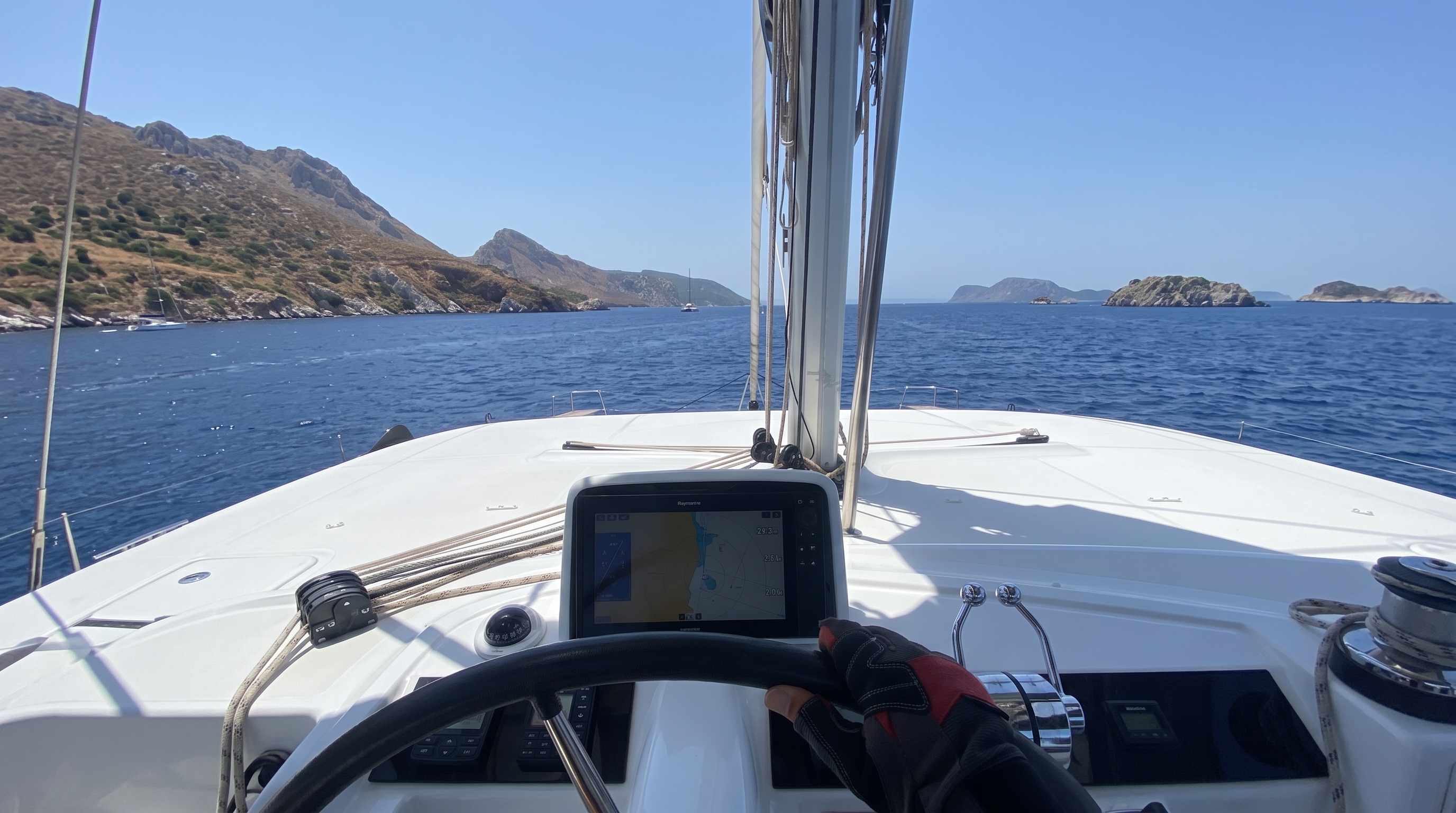
Here, geography ceases to be mere scenery and transforms into Songlines of Becoming. These are not simple, one-directional paths, nor are they sentimental retreats into a lost youth. They are complex, resonant lines that reach deep into the subterranean strata—traversing personal memory, the collective cultural subconscious, and the grey light of an archaic dawn—while surging boldly toward the future. Every strait crossed under sail, every ruin touched on the Peloponnesian coast, and every volcanic ridge walked upon becomes a verse in an ongoing re-creation of the self. By tracing these physical and temporal lines, the landscape is re-enchanted into an operative atelier where origin and destiny converge.
III. The Spolia of the Self: Forging Late Sovereignty
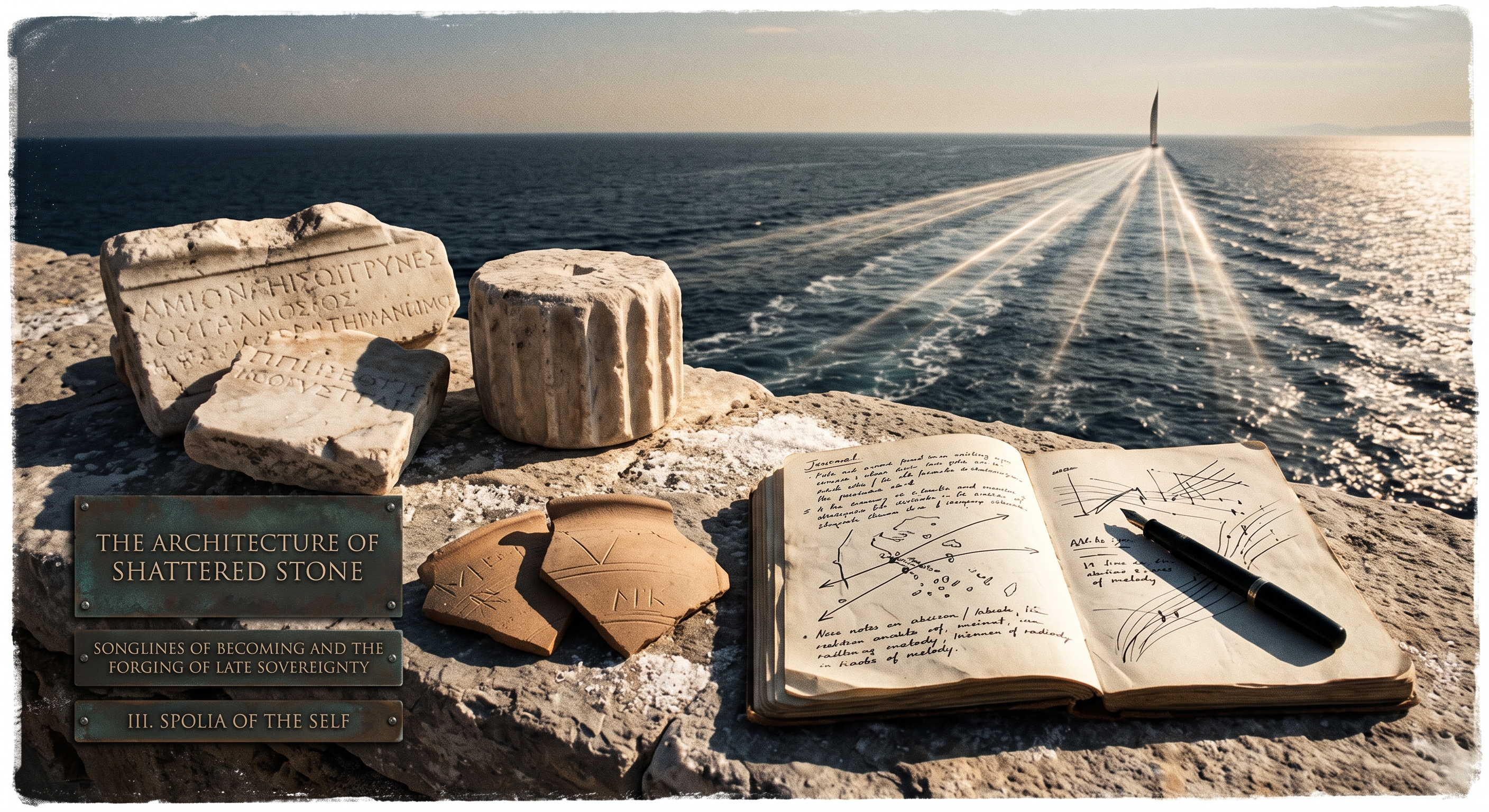
Sovereignty in the third act of life is not born from a pristine, unbroken path. It is forged by looking at the scattered shards—the abandoned drafts, the departed illusions, the half-century of unresolved trajectories—and refusing to mourn them as failures. Instead, the shards become raw building blocks. Just as medieval fortress builders raised defensive bastions out of the fractured marble drums of fallen temples, the late artist repurposes personal wounds, archaic obsessions, and accumulated maritime memory into a singular, weaponized creative act.
To claim existential autonomy in late maturity is to stop asking for permission, audience validation, or external consensus. It demands an ethos where seeing is an act of construction, where the lens and the pen do not merely record reality, but impose order upon chaos. By walking and singing these deep-rooted lines through the open sea, the fragment ceases to be an excuse for incompletion. It becomes the bedrock of an enduring, sovereign work.
Die Architektur des zerbrochenen Steins (DE)
Songlines of Becoming und die späte Souveränität
Der Essay entlarvt die trügerische Behaglichkeit einer endlosen Vorbereitung im virtuellen Schutzraum und beschreibt die Überwindung lebenslanger Lähmung durch einen radikalen, operativen Schnitt. Ausgelöst durch existenzielle Krisen verlagert sich das Dasein aus dem digitalen Limbus in die physische Härte des mediterranen Raums, wo Geografie zu tief verankerten Songlines of Becoming transformiert wird – kraftvollen, vielschichtigen Strahlen, die zugleich tief in das persönliche wie kollektive Unterbewusstsein hinabreichen und als offene Resonanzachsen in die Zukunft weisen. Späte Souveränität errichtet keine starren Bastionen, Denkmäler oder monolithischen Pyramiden mehr; sie verwirklicht sich in einer radikalen Ästhetik der Fluidität. Indem biografische Wunden, verworfene Entwürfe und antike Resonanzen wie Spolien (Spolia) in eine dynamische, fließende Form aufgenommen werden, zementiert sich das Leben nicht als starres Monument, sondern wird zum unaufhörlichen Weitergehen und Weitersingen auf offenem Kurs durch Raum und Zeit – ohne noch nach Bestätigung oder Erlaubnis zu fragen.